
Nullam dignissim, ante scelerisque the is euismod fermentum odio sem semper the is erat, a feugiat leo urna eget eros. Duis Aenean a imperdiet risus.

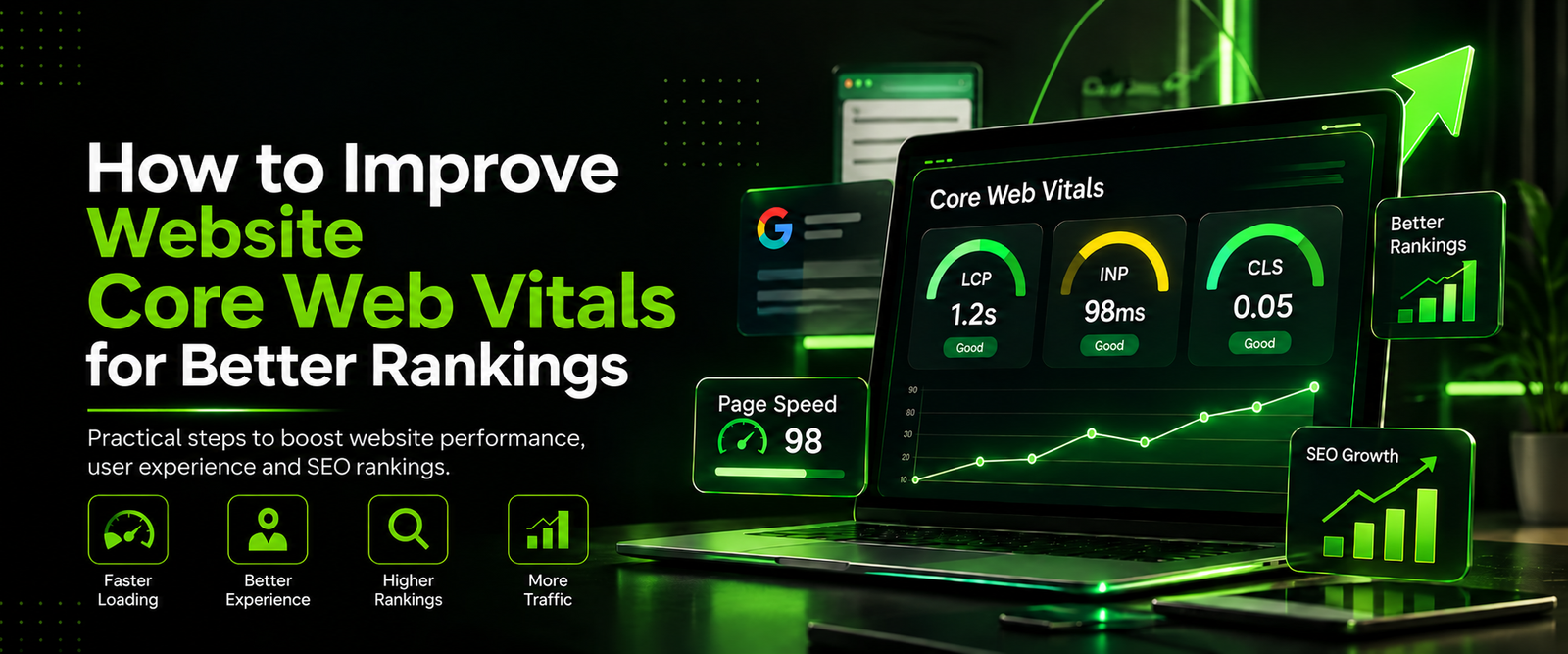
How to Improve Website Core Web Vitals for Better Rankings
Core Web Vitals are Google’s standardized metrics for real-world user experience on a web page. They measure loading speed, interactivity, and visual stability during page load.
These signals feed into Google’s page experience rankings. Additionally, this guides How to Improve Website Core Web Vitals for Better Rankings as a concrete objective.
Improving Core Web Vitals is a practical technical investment. Moreover, it can lead to better search rankings, lower bounce rates, and higher conversions.
First, this guide breaks down each metric.
It explains how to measure it accurately.
Finally, we walk through the fixes that deliver the biggest gains.
What Are Core Web Vitals?
Firstly, Core Web Vitals consist of three user-centric metrics. These metrics assess page performance.
- Largest Contentful Paint (LCP): measures loading performance. A good LCP is 2.5 seconds or less.
- Interaction to Next Paint (INP): measures responsiveness across all interactions during a visit. A good INP is 200 milliseconds or less. INP replaced First Input Delay (FID) as the official responsiveness metric.
- Cumulative Layout Shift (CLS): measures visual stability. A good CLS score is 0.1 or less.
Google evaluates these metrics at the 75th percentile of real user visits, separately for mobile and desktop. This means three out of four visits must meet the “good” threshold. Therefore, a page passes only when it does.
Why Core Web Vitals Matter for SEO Rankings
Core Web Vitals are part of Google’s page experience signals. Additionally, relevance and content quality remain the dominant ranking factors. Strong vitals act as a tiebreaker when competing pages are similar in quality.
- Lower bounce rates, because users stay on pages that load fast and behave predictably.
- Higher conversion rates, as faster, more stable pages reduce friction at checkout and form submission.
- Better crawl efficiency, since lightweight, fast-responding pages are easier for Googlebot to process.
- Stronger mobile performance, which matters because Google uses mobile-first indexing.
How to Measure Core Web Vitals Accurately
Effective optimization starts with reliable data. Additionally, we recommend combining field data with lab data.
Field Data Tools
- Google Search Console (Core Web Vitals report): groups URLs by status (Good, Needs Improvement, Poor) using real user data from the Chrome User Experience Report.
- PageSpeed Insights: shows both field data and a lab diagnosis for any URL.
- CrUX Dashboard and the web-vitals JavaScript library: let us collect and monitor real-user metrics on our own site.
Lab Data Tools
- Lighthouse (in Chrome DevTools): provides actionable audits and a performance trace.
- WebPageTest: offers waterfall charts, filmstrips, and testing from multiple locations and devices.
Field data tells us what real users experience; lab data tells us why. Therefore, we use both to prioritize fixes.
How to Improve Largest Contentful Paint (LCP)
LCP is usually triggered by a hero image, a large heading, or a video poster. Additionally, to bring it under 2.5 seconds, we address four components. These are server response time, resource load delay, resource load duration, and render delay.
How to Improve Website Core Web Vitals for Better Rankings guides practical optimization strategies for this goal.
Reduce Server Response Time (TTFB)
- Upgrade to high-performance hosting or a managed platform with modern infrastructure.
- Deploy a Content Delivery Network (CDN) to serve content from locations close to users.
- Enable server-side caching and full-page caching for dynamic CMS platforms such as WordPress.
- Optimize database queries and remove slow plugins or backend processes.
Optimize and Prioritize the LCP Element
Additionally, optimize and prioritize the LCP element.
- Serve images in modern formats such as WebP or AVIF.
- Use responsive images with
srcsetandsizesso devices download only what they need. - Never lazy-load the LCP image. Instead, add
fetchpriority="high"to it so the browser fetches it first. - Use
<link rel="preload">for critical hero images and key fonts. - Compress images aggressively without visible quality loss.
Eliminate Render-Blocking Resources
- Inline critical CSS needed for above-the-fold content and defer the rest.
- Add
deferorasyncto non-critical JavaScript. - Remove unused CSS and JavaScript through code splitting and tree shaking.
- Minify HTML, CSS, and JavaScript.
Optimize Web Fonts
- Use
font-display: swapto show text immediately with a fallback font. - Self-host fonts where possible and preload the primary font file.
- Subset fonts to include only the characters we actually use.
How to Improve Interaction to Next Paint (INP)
INP captures the delay between a user’s interaction (click, tap, or key press) and the next visual update. However, poor INP almost always comes from a busy main thread.
Reduce JavaScript Execution Time
- Break up long tasks (any task over 50 ms) into smaller chunks using
setTimeout,requestIdleCallback, orscheduler.yield(). - Remove or defer unnecessary third-party scripts such as chat widgets, heatmaps, and excessive tracking tags.
- Load non-essential scripts after user interaction or when they enter the viewport.
- Use web workers to move heavy computation off the main thread.
Optimize Event Handlers
- Keep event callbacks lightweight and avoid synchronous layout-triggering operations inside them.
- Debounce or throttle handlers for scroll, resize, and input events.
- Avoid forced reflows by batching DOM reads and writes.
Minimize DOM Size and Rendering Cost
- Keep the DOM lean. Pages with excessively large DOM trees (thousands of nodes) slow down every interaction.
- Use
content-visibility: autofor off-screen sections to skip unnecessary rendering work. - Avoid deep nesting and overly complex CSS selectors.
How to Improve Cumulative Layout Shift (CLS)
Layout shifts frustrate users and cause misclicks. Moreover, the goal is to reserve space for every element before it loads.
Set Explicit Dimensions
- Always include width and height attributes on images and video elements, or use the CSS
aspect-ratioproperty. - Reserve fixed space for ads, embeds, and iframes using placeholder containers with defined dimensions.
Handle Dynamic Content Carefully
- Never insert content above existing content unless it is in response to a user action.
- Place cookie banners and notification bars in a way that does not push page content down after load, such as overlaying them or reserving their space in advance.
- Use CSS transforms for animations instead of properties that trigger layout, such as
top,left, orheight.
Prevent Font-Related Shifts
- Match fallback font metrics to the web font using
size-adjust,ascent-override, and related descriptors. - Preload critical fonts to shorten the swap window.
Technical Optimizations That Improve All Three Metrics
However, some improvements lift every Core Web Vitals score at once.
- Enable HTTP/2 or HTTP/3 for faster, multiplexed delivery of resources.
- Use Brotli or Gzip compression on all text-based assets.
- Set long cache lifetimes with fingerprinted filenames for static files.
- Use
preconnectanddns-prefetchfor critical third-party origins. - Adopt the back/forward cache (bfcache) by avoiding patterns that block it, such as
unloadhandlers. - Audit and trim plugins, themes, and page builders that add unnecessary weight.
Core Web Vitals Optimization for WordPress and CMS Sites
Content management systems often carry hidden performance costs. Additionally, for WordPress and similar platforms, we recommend:
- Choosing a lightweight, performance-focused theme.
- Using a reputable caching and optimization plugin configured for page caching, CSS/JS minification, and lazy loading below the fold.
- Removing inactive plugins and replacing heavy ones with lighter alternatives.
- Using an image optimization workflow that automatically converts uploads to WebP or AVIF.
- Limiting the number of page-builder widgets and animations per page.
A Practical Core Web Vitals Optimization Workflow
- Audit: Review the Search Console Core Web Vitals report to identify failing URL groups.
- Diagnose: Run PageSpeed Insights and Lighthouse on representative templates, not just individual pages.
- Prioritize: Fix issues affecting the largest number of URLs and highest-traffic pages first.
- Implement: Apply fixes at the template level, such as header, hero section, and fonts, for site-wide impact.
- Validate: Use the “Validate Fix” feature in Search Console and monitor field data over the following 28 days, since CrUX data uses a rolling window.
- Monitor: Set up continuous real-user monitoring so regressions are caught immediately after new deployments.
Common Core Web Vitals Mistakes to Avoid
- Chasing a perfect Lighthouse score instead of improving real-user field data.
- Lazy-loading everything, including the LCP image, which delays the most important element.
- Overloading pages with third-party tags that block the main thread.
- Ignoring mobile performance, where slower CPUs and networks expose problems first.
- Optimizing only the homepage while product, category, and blog templates fail.
Frequently Asked Questions About Core Web Vitals
What is a good Core Web Vitals score?
A page passes when LCP is under 2.5 seconds, INP is under 200 milliseconds, and CLS is under 0.1, measured at the 75th percentile of real user visits.
How long does it take to see improvements in Search Console?
Because field data is aggregated over a rolling 28-day period, improvements typically appear gradually over about a month after fixes are deployed.
Do Core Web Vitals directly improve rankings?
They are a confirmed part of Google’s page experience signals. Strong vitals will not compensate for weak content, but they can provide a competitive edge between similarly relevant pages and significantly improve user engagement.
Which metric should we fix first?
We start with whichever metric is failing on the greatest number of URLs. For most sites, that is LCP, followed by INP on script-heavy pages and CLS on ad-supported or media-rich layouts.
Conclusion
Improving Core Web Vitals is a systematic process: measure with real-user data, diagnose with lab tools, fix issues at the template level, and monitor continuously. By accelerating LCP, tightening INP, and stabilizing CLS, we create faster, smoother experiences that users appreciate and search engines reward. Sites that treat performance as an ongoing discipline, not a one-time project, consistently hold stronger positions in search results.